
It’s a Monday morning. The waiting room has a limping Labrador and a cat in a carrier, a dental is prepped for 9:00, and two hospitalized patients need their treatment sheets updated. Then the practice management system won’t load.
Maybe the server failed overnight. Maybe a storm knocked out the internet and your cloud software is unreachable. Maybe it’s ransomware. Whatever the cause, the questions are the same: Who does what right now? What can you still access? How long until you’re back?
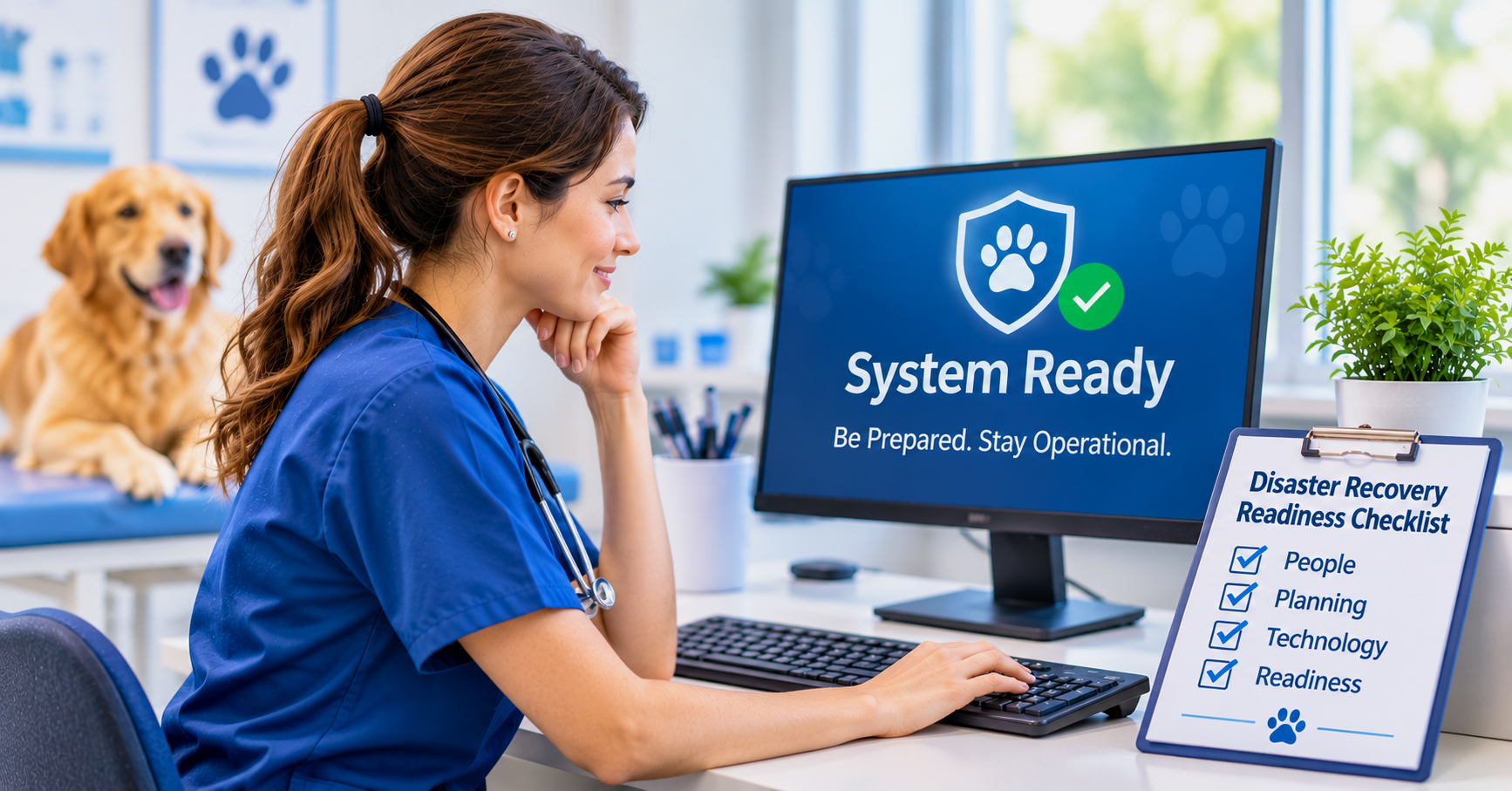
Most veterinary clinics have some pieces of a disaster recovery plan in place. Few have tested whether those pieces actually work together. This guide walks through 12 readiness checks across four areas: people, planning, technology and readiness. It ends with a quick way to score your clinic.
The Quick Answer
A veterinary clinic is ready for an outage when its team knows their roles, its critical systems are identified and prioritized, its backups have been restored successfully in a test, and it has practiced running the practice without its usual systems. You can check where your clinic stands in about three minutes with Tier3MD’s free Disaster Recovery Readiness Assessment.
Why Outages Hit Veterinary Clinics Differently
A veterinary clinic isn’t a typical small office. When systems go down, the impact reaches the exam room, the treatment area and the front desk all at once:
- Hospitalized and boarding patients still need medications, monitoring and records, outage or not.
- Diagnostic imaging may be stored on a local server or imaging workstation, separate from your practice management software (PIMS). If it fails, X-rays and ultrasound studies can become unavailable mid-case.
- Controlled-substance logs must stay accurate and available.
- Cloud PIMS depends on your internet connection. An internet outage can feel exactly like a server crash.
- Records must remain available. Georgia Board of Veterinary Medicine Rule 700-12-.04 requires practices to keep patient records, including diagnostic imaging, for at least three years.
The risk isn’t theoretical. In 2019, a ransomware attack on National Veterinary Associates disrupted roughly 400 of its hospitals, cutting off access to patient records, payment systems and practice software. And disruptions don’t always come from attackers: power outages, failed hardware and severe weather cause plenty of downtime too, especially for coastal Georgia practices during hurricane season.
The 12 Readiness Checks
These 12 checks match the four areas in Tier3MD’s assessment. For each one, ask: Is this true for my clinic today?
People
- We know how we’ll communicate with clients during a disruption. If your phones, email or texting platform go down, how will you reach clients with appointments, surgical patients or pets in boarding? Keep an offline list of today’s and tomorrow’s appointments, plus a template message you can send from another channel.
- Roles and responsibilities are clearly defined. During an outage, someone needs to call your IT provider, someone needs to switch the front desk to paper and someone needs to tell the doctors. Name those people in advance, with backups for each role.
- Key team members understand the recovery plan. A plan in the practice manager’s drawer doesn’t help if the practice manager is on vacation. Make sure at least two people per shift know where the plan is and how to start it.
Planning
- We have a documented disaster recovery plan. It doesn’t need to be long. It does need to be written down, with contacts, priorities and step-by-step actions, and stored somewhere you can reach when your systems are down.
- We know which systems and data are most critical. Rank your systems: PIMS, imaging, lab analyzers, payments, phones, email. Then decide how long the clinic can realistically operate without each one. A practice impact analysis helps put numbers to these decisions, and so does knowing what an hour of downtime really costs.
- Our plan is reviewed and updated regularly. Update it whenever something changes: a new PIMS, a move from server to cloud, a new imaging system, a second location or new staff. A plan written for your old server-based software may not work for your new cloud platform.
Technology
- Our data is backed up consistently. Back up PIMS data, imaging archives and other critical files automatically, with at least one copy kept off-site or protected against alteration. If your PIMS is cloud-based, confirm what your vendor backs up and what you still hold locally. Our post on cloud backup myths covers the most common gaps.
- We test that our backups can be restored. This is the check clinics fail most often. A backup only has value if you can restore from it. Schedule regular test restores, including imaging, and record how long they take. Learn the difference between backup and full continuity.
- Critical systems can be recovered within an acceptable timeframe. If your clinic can only tolerate four hours without its PIMS, your recovery setup has to deliver in four hours. For cloud systems, that may mean a backup internet connection. For server-based systems, it may mean faster recovery hardware or a cloud recovery option.
Readiness
- We practice our recovery procedures. Run a short drill: “The PIMS is down for two hours. Go.” Can the front desk check patients in on paper? Can doctors reach the previous visit notes they need? Drills reveal problems while there’s no real emergency.
- We know how we’ll communicate during an outage. Internal communication matters as much as client communication. Agree on a backup channel, such as a group text, for when email or the phone system is unavailable.
- We look for ways to improve our preparedness. After every outage or drill, write down what went wrong and fix one thing. Readiness improves in small steps, not one big project. Our list of the most common practice disruptions is a good place to look for gaps.
How Did Your Clinic Score?
Count how many of the 12 statements are true for your clinic today:
- 10–12 checks: Your clinic is well prepared. Keep testing and updating.
- 6–9 checks: You’ve made progress, but there may be gaps worth addressing.
- 0–5 checks: It’s time to strengthen your recovery strategy before a disruption puts it to the test.
For a more structured result, take Tier3MD’s free Disaster Recovery Readiness Assessment. It takes about three minutes. You’ll get:
- A readiness score out of 12
- Your strongest and weakest areas
- Practical next steps
- The option to request a conversation with a Tier3MD disaster recovery specialist
The assessment offers general educational guidance and is not a formal compliance or cybersecurity audit.
How Tier3MD Helps Veterinary Clinics Recover Faster
Tier3MD’s Veterinary IT Management and Business Continuity services help animal hospitals and clinics across Georgia and the Southeast prepare for, and recover from, disruptions:
- Disaster recovery services to restore records and systems after an incident
- 24/7 network monitoring to catch problems before they stop appointments
- Ransomware protection and a Security Operations Center that watches for threats
- Support for digital X-ray, imaging and lab equipment software
- Help moving from server-based to cloud practice software without losing access to records
Frequently Asked Questions
What is a disaster recovery plan for a veterinary clinic?
It’s a documented plan that helps a clinic restore its critical systems, such as the PIMS, imaging and payments, access the data it needs, communicate during an outage and resume normal operations after a disruption.
If our practice software is in the cloud, do we still need a disaster recovery plan?
Yes. Cloud software protects the vendor’s servers, but your clinic still depends on its internet connection, workstations, imaging equipment, phones and locally stored files. Your plan should cover all of them.
How often should a veterinary clinic test its backups?
Test restores regularly, at least quarterly, and after any major system change, such as a new PIMS or imaging system.
How often should we update our disaster recovery plan?
Review it on a set schedule, such as once a year, and whenever your systems, vendors, locations or staff responsibilities change.
Is the Tier3MD readiness assessment a formal compliance audit?
No. It’s a free, three-minute educational tool that highlights possible gaps. A formal assessment requires a tailored review by qualified professionals.
Find Out Where Your Clinic Stands
The best time to discover a gap in your recovery plan is before you need it. Take three minutes now and see how ready your veterinary clinic really is.
Start the free Disaster Recovery Readiness Assessment, or call +855-698-4373 to talk with Tier3MD about your clinic’s recovery plan.